Zero hundred, accelerate for 4.0s! On September 9th, Dading Lock Order was delivered on September 30th, and Weilai ET5 mirror powder was unveiled at the auto show.

With the arrival of this year’s Chengdu Auto Show, major car companies have begun to build momentum for their own heavy new cars. As the leader of the new force in car-making, Weilai ET5 mirror powder, a subsidiary of Weilai Automobile, appeared at this auto show. At present, a lot of information about this new car has been released. New carThe big lock order will be opened on September 9, and the first batch of new cars will be delivered on September 30.

What information did Weilai ET5 announce at this conference? Let me take a look:

Accelerate from zero to 4.0s,

The braking distance of 100 kilometers is 33.8m,

The standard battery pack has a capacity of 75kWh.

The cruising range is increased to 560 kilometers under CLTC working conditions; The long battery life is 100kWh and the battery life is 710 kilometers.

Standard: HRS shock absorber, suspension does not support FOTA upgrade, LCC lane center/ALC lighting lane change, HOD capacitance sensing steering wheel, and trailer set is added, and the delivery time is in December;

It can be seen that Weilai ET5 not only upgraded the integrated seat, but also improved the acceleration time of the vehicle. Now the new car only takes 4.0 seconds. The braking distance of 100 kilometers only needs 33.8 meters. In addition, the new car ET5 also comes standard with LCC lane centering and ALC automatic lane change.HRS shock absorber, HOD capacitive sensing steering wheel,New and "Huayang No.1" fragrances are available for selection, andAdd a trailer set. It is equipped withWeilai ET5, a trailer set, will not be delivered until December.

In terms of price, if it is purchased by BaaS battery rental scheme,thatBefore subsidy, the selling price is 258,000 yuan, of which the monthly battery fee for 75kWh models is 980 yuan, and that for 100kWh models is 1,480 yuan. If the vehicle is purchased, the price of the model with 75kWh battery before subsidy is 328,000 yuan, and that of 100kWh is 386,000 yuan.

Weilai ET5 adopts a hatchback roof design with smooth side lines, and the taillights with penetrating design are also popular at present. Unfortunately, the laser radar at the top of the vehicle is a bit abrupt. In terms of body size, the length, width and height of the new car are 4790mmx1960mmx1499mm respectively, and the wheelbase of the car is 2888 mm.

In the interior, the new car still continues the concept of "second living room" dominated by Weilai. Whether it’s invisible air outlet design, exquisite and neat instrument panel, intelligent frameless electric suction door, and the use of Clean+ environmental protection fabric materials, Weilai ET5 is still very powerful.

In terms of automatic driving, ET5 is equipped withWeilaiAutomatic driving technology NAD, atWeilaiWith the support of extrasensory system Aquila and supercomputing platform Adam, Weilai ET5 will gradually realize the point-to-point automatic driving experience in expressway, urban road, parking, power exchange and other scenes. In addition, the complete functionWeilaiThe NAD function of autonomous driving technology adopts the service subscription mode, that is, "monthly opening and monthly payment".

In the power configuration part, Weilai ET5 adopts the dual-motor four-wheel drive mode, in which the induction motor is 150kW and the rear permanent magnet motor is 210kW. The overall system power of the whole vehicle can reach 360kW and the maximum peak torque is 700 N m. In terms of battery life, under CLTC working conditions, the standard battery life model with 75kWh battery pack has a battery life of 560 kilometers, and the long battery life model with 100kWh battery pack has a battery life of 710 kilometers.

South Korea plans to include Japan in the export white list and lift the export control measures to South Korea on the same day.

  The South Korean government will issue a notice on the import and export of strategic materials on the 24th, putting Japan back on the "white list" to enjoy simplified export procedures.

  According to Yonhap News Agency, after the summit meeting between Japan and South Korea last month, relations between the two countries improved. On April 21, local time, the Ministry of Industry, Trade and Resources of the Republic of Korea said that the ROK initiated the process of re-listing Japan in the export white list. Previously, on September 18, 2019, the South Korean government removed Japan from the export white list in response to Japan’s export control to South Korea.

  Yonhap News Agency reported that it is expected that the return of bilateral economic and trade cooperation between Japan and South Korea will be put on the agenda in an all-round way. At present, the South Korean government first re-added Japan to the export white list, but it will take time for South Korea to return to Japan’s export white list. An official from the Ministry of Industry of the Republic of Korea said that the domestic procedures in Japan are more complicated than those in South Korea, so it takes more time to add South Korea to the white list.

  The official said that after the ROK first takes measures within its power, it will appeal to the Japanese side to respond. At present, South Korea and Japan are conducting further consultations on export whitelist and other matters.

  According to a previous report by Japan’s Kyodo News Agency, the two heads of state reached an agreement on the normalization of relations after holding talks on March 16 this year. The Japanese government announced on March 23 that the strengthening measures for export control of three semiconductor-related raw materials to South Korea launched in 2019 have been lifted. On the 16th, the South Korean government announced that it would suspend the lawsuit filed with the World Trade Organization (WTO) for the cancellation of the enhanced measures, and the Japanese government also said on the same day that it would lift the measures.

Wuling Hongguang plus steering wheel function introduction

Explore the steering wheel charm of Wuling Hongguang PLUS

五菱宏光plus

Wuling Hongguang PLUS’s intelligent driving technology has led the new trend, and it is equipped with an advanced EPS electronic power steering system. When you drive, you don’t need to use too much force, just turn lightly and the steering wheel responds accurately.Farewell to the past of wrestling with mechanical powerThis design is designed to provide a more comfortable and convenient driving experience

In terms of steering performance, Wuling Hongguang PLUS excels, and the steering wheel responsiveness and accuracy meet the standards of family cars. It provides a steady steering force, and each lap is carefully adjusted to maintain flexibility without appearing too heavy. In daily driving, whether it is driving at high speed or low speed, the electric power assist system can seamlessly switch,Ensure lightness at low speeds and stability at high speeds

Wuling Hongguang PLUS knows that steering accuracy is not the only pursuit for the driver. It focuses more on driving comfort and practicality, so that the driver can enjoy a relaxed and pleasant handling experience during the daily journey. Therefore, although accuracy is not the core, it plays an important role in the overall driving experience.

Whether a novice or an experienced driver, the steering wheel design of Wuling Hongguang PLUS is designed to provide drivers with excellent handling and convenience, making every turn a relaxed and enjoyable experience.

Shared office is sought after, and there are huge business opportunities to help office buildings "destock"

  Xinhua News Agency, Chengdu, November 6 (Yang Wenhao, Hu Xu) Shared office is booming under the wave of sharing economy and double innovation. Many shared office enterprises, including SOHO China, have recently set their sights on Chengdu. With a large number of projects landing one after another, the long-term surplus office market in Chengdu has also ushered in a "warm winter".

  WORK+ joint office space located in Tianfu New Valley, Chengdu High-tech Zone, has become one of the hottest shared office projects in Chengdu at present because of cutting-edge and fashionable decoration design and housekeeper-style intimate service. Its two-story space of nearly 8,000 square meters provides more than 800 workstations, which have served more than 50 small and micro enterprises.

  WORK+ is just a microcosm of shared office being sought after in Chengdu. In recent years, Chengdu’s "double innovation" policy has been further promoted, entrepreneurial groups have been growing, and a large number of small and micro enterprises have emerged rapidly. Start-up companies have small teams and insufficient funds, and the shared office with relatively high cost performance has become their first choice.

  The increase in demand immediately leads to the expansion of supply. Many well-known shared office service providers, such as Dream Plus, Chivalrous Island, Sugar Cube Town and Walnut, have settled in various office buildings in Chengdu. The latest entrant is SOHO 3Q shared office project under SOHO China.

  Pan Shiyi, chairman of SOHO China, believes that from the perspective of market acceptance, Chengdu’s main population has been on the same starting line as first-tier cities, and there are huge business opportunities for sharing office.

  According to the data released by Colliers International, a real estate service company, the vacancy rate of Chengdu office market has remained above 30% for a long time due to long-term oversupply. In the third quarter of this year, although two new projects brought a huge supply of nearly 100,000 square meters, the average vacancy rate increased slightly by only 0.1% from the previous month.

  In this regard, Colliers International reported that with the continuous optimization of the economic and investment environment, the upgrading of industrial structure and the expansion of the consumer market in Chengdu, a large number of domestic and foreign enterprises have expanded here, especially the rapid development of science and technology and joint office industries, which has led to a significant increase in the cases of bulk leasing and rent expansion in the Grade A office market.

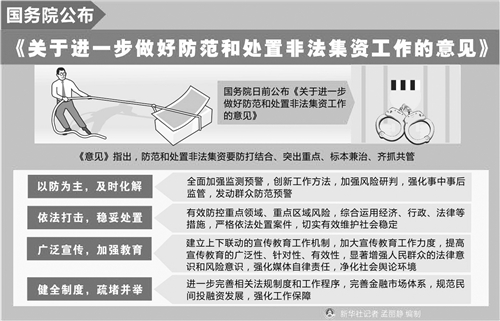
Rectify the ills of illegal fund-raising from the source

On February 4th, the State Council released the Opinions on Further Improving the Prevention and Disposal of Illegal Fund-raising. The "Opinions" put forward the regulatory concept of "combining prevention with crackdown, cracking down early and cracking down on small ones", clarified the regulatory responsibilities for preventing and handling illegal fund-raising, based on establishing a long-term mechanism, and tried to solve the problem of illegal fund-raising flooding from the source by perfecting relevant laws and regulations. The reporter of Economic Daily interviewed relevant experts to interpret the Opinions.

Governance according to law, classification and policy

Experts believe that the Opinions fully embodies the concept of "managing illegal fund-raising according to law" and establishes the principle of classified policy.

Li Aijun, a professor at the School of Civil and Commercial Economics of China University of Political Science and Law, said that according to the requirements of the Opinions, the governance of illegal fund-raising should obey the established laws, and he also proposed that the established laws and related legislation in China should be revised in time according to the characteristics of illegal fund-raising. "At present, illegal fund-raising methods are being refurbished to avoid laws and regulations, which leads to the lag of existing laws and regulations. Perfecting the relevant legal system is an important way to cure illegal fund-raising. "

The cases of illegal fund-raising are complex, involving a wide range of aspects and strong policies. In order to effectively resolve contradictions and strive to achieve the organic unity of law enforcement and social effects, the Opinions have established the principle of strict handling according to law and classified policies.

Liu Weibo, the presiding judge of the Second Criminal Court of the Supreme People’s Court, said that according to the requirements of the Opinions, it is necessary to strictly distinguish between illegal fund-raising and legal private lending, and between criminal offences and administrative violations. If illegal fund-raising or illegal fund-raising does not constitute a crime according to law, and production and business activities can continue, it is necessary to actively help and guide enterprises to take the initiative to rectify and avoid expanding losses. At the same time, we must adhere to the criminal policy of combining leniency with severity, severely crack down on major criminal cases of illegal fund-raising in key areas, key regions and key links, and be lenient in accordance with the law if the illegally absorbed funds are mainly used for normal production and business activities and can be repaid in time.

At present, illegal fund-raising tends to spread to different regions and industries. To effectively prevent and deal with illegal fund-raising, it is necessary to strengthen leadership, participate in many parties and form a joint force. "The Opinions also emphasize the construction of a work pattern in which the division of labor is responsible for linkage and cooperation." Liu Weibo said.

Li Aijun said that at present, with the rapid spread and wide coverage of Internet technology, Internet-based illegal fund-raising has the characteristics of cross-sectoral, cross-regional, cross-industry and regional, and governance of Internet-based illegal fund-raising requires all-round cooperation.

The combination of dredging and plugging focuses on prevention

The prevention and disposal of illegal fund-raising is a long-term, complex and arduous systematic project. To effectively prevent and control the risk of illegal fund-raising, we must change our ideas, innovate our mechanisms and improve our methods. "The Opinions put forward the important concept of’ two combinations’, that is, the combination of prevention and suppression and the combination of unblocking." Liu Weibo said that the key to achieving the goal of early detection and early resolution of illegal fund-raising is prevention.

Among them, prevention means nip in the bud, and do a good job in monitoring and early warning, daily supervision, investigation and evaluation of illegal fund-raising risks; Fight, that is, fight early and fight small, and severely crack down on key areas, key areas and major vicious illegal fund-raising cases according to law; Sparse is to continuously improve the level of financial services through reform, broaden private investment and financing channels, vigorously develop inclusive finance, and effectively solve the contradiction between financial supply and demand; Blocking is to clarify the boundaries of policies and laws by improving laws and regulations, and resolutely block all kinds of illegal fund-raising and criminal activities carried out under the banner of production and operation, commodity trading, financial innovation and internet finance.

Liu Weibo believes that only by taking precautions in place, cracking down effectively, unblocking the right path, blocking evil paths, and taking multiple measures simultaneously can we get out of the strange circle of "letting chaos control death" and achieve the effect of treating both the symptoms and the root causes.

Peng Bing, a professor at Peking University Law School, said that once the risk of illegal fund-raising breaks out, it is often difficult to pay, and it is difficult for investors to recover their funds. The Opinions focus on prevention in cracking down on illegal fund-raising activities, which has strong practical significance.

The development of illegal fund-raising activities needs to rely on some channels that are convenient to the public, such as advertising, and various organizations that have obtained sales licenses to promote illegal wealth management products. Peng Bing said, "Setting up monitoring in these channels can detect illegal fund-raising activities as early as possible and nip them in the bud." The Opinions also proposes to strengthen the monitoring and inspection of advertisements.

Monitoring the capital flow is helpful for early detection of illegal fund-raising activities. "Most funds for illegal fund-raising activities need to go through financial institutions. Strengthening the monitoring of anti-money laundering by financial institutions will effectively find suspected illegal fund-raising activities in the early stage." Peng Bing said that the Opinions clarify that financial institutions should identify and report suspicious trading activities suspected of illegal fund-raising on the basis of anti-money laundering.

At the same time, the Opinions also emphasize the role of "publicity and education" in preventing and handling illegal fund-raising. "Through publicity and education for the masses, let them master certain basic knowledge and common sense of finance and law, which will not only make the masses invest more rationally, but also improve their self-protection ability, and will also play a guiding role in the whole society." Li Aijun said.

Carry out the responsibility without leaving a vacuum

Li Aijun believes that the Opinions further improve the responsibility mechanism for preventing and disposing of illegal fund-raising. For example, in the Opinions, it is clear that the provincial people’s government is the first responsible person to prevent and dispose of illegal fund-raising, and the local people’s governments at all levels should effectively implement the responsibilities of territorial management, and make detailed provisions on the scope of responsibility and the assessment methods of responsibilities of each responsible subject. This fully reflects the government’s determination to control illegal fund-raising. Only when the responsibility is clear and operational can it be truly implemented and effective, and it can ensure that there is no vacuum in the supervision and prevention of illegal fund-raising in all industries.

"In addition, the Opinions stipulate the responsibilities of relevant departments from the principle of whether supervision is linked to market access and industry management, which inhibits the current illegal fund-raising and use of the lack of supervision system to engage in illegal and criminal activities." Li Aijun said that the current illegal fund-raising with the help of Internet technology has circumvented the regulatory agencies and competent authorities. With the promulgation of the Opinions, local people’s governments at all levels will be responsible for the supervision and management of all kinds of "innovations" that evade regulatory agencies and competent institutions, which will fundamentally prevent the risks brought by all kinds of pseudo-innovations.

Liu Weibo said that while clarifying the main body of responsibility and refining the division of responsibilities, the Opinions put special emphasis on the accountability mechanism, and incorporated the prevention and disposal of illegal fund-raising into the comprehensive assessment and evaluation of leading bodies and leading cadres of people’s governments at all levels. The financial supervision department will also establish an accountability system while guiding and urging financial institutions to strengthen internal management, social propaganda, monitoring and reporting. (Reporter Chang Yanjun)

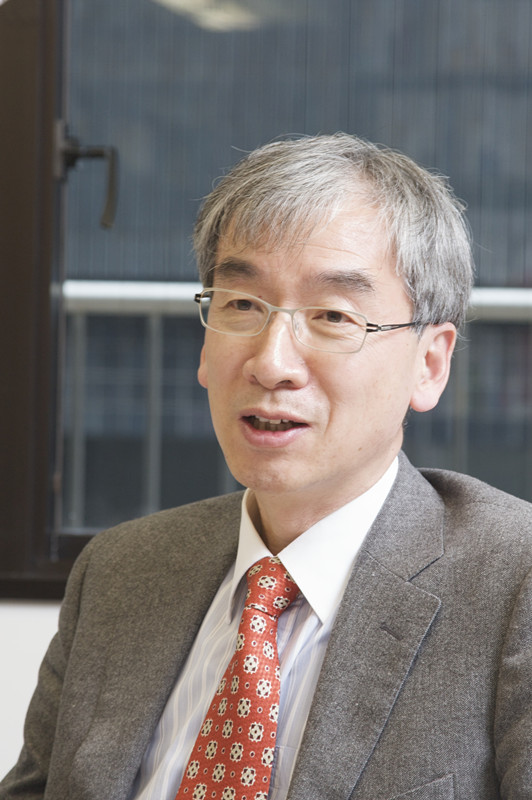
Interview with Bai Yongrui: My life and ideological experience

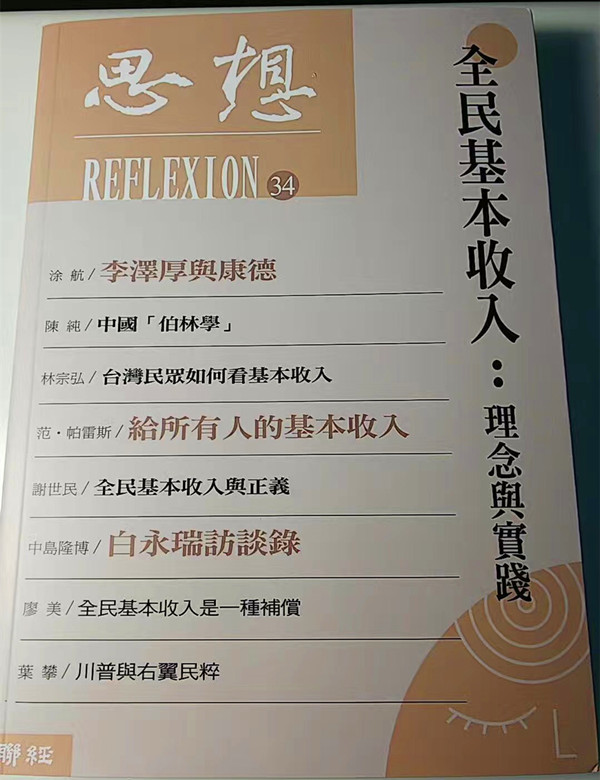
[Editor’s Note] This interview was conducted in Seoul on August 24th, 2015. The interviewer was Professor Takahiro Nakajima of the Center for Philosophy Research of the University of Tokyo, Japan, and the interviewee was Professor Bai Yongrui of Yonsei University, South Korea, with Jin Hang as the translator. The original title of this article is "Giving Vitality to the Gap: An Interview with Bai Yongrui", which was signed by the author as "Conversation between Nakajima Takabo and Lu Chan" and published in Thought magazine (published by Lianjing Publishing Company on December 14, 2017). Reprinted by The Paper with authorization. The original interview was 20,000 words long, and here are some excerpts. There are notes in the original text, which are omitted here.

I. Born in Incheon shortly after the signing of the Korean Armistice Agreement.

Nakajima Takahiro:When planning this dialogue, two texts came to my mind. One is a dialogue between Emmanuel Lévinas and Philip Nemo. This was originally an interview in a radio program, and later it was compiled into a book called Ethics and Infinity. This book is very good. Levinas talks about his philosophy in it, and there are some things that he may not put into writing. On the question "What kind of philosophy is Levinas’ philosophy?", he expounded it in his own words, which is very simple and easy to understand. I want to use this as a model to talk to you today. The dialogue between Levinas and Nemo began with the former’s childhood memories, and another text that came to my mind happened to be walter benjamin’s Childhood in Berlin around 1900. Today, I want to start a dialogue with these two texts as examples. First of all, please ask Professor Bai to recall his childhood and let everyone know the story of Bai Yongrui (= history).

Benjamin said in the book: "The picture of my urban childhood may be able to shape the future historical experience in advance." He listed his unique historical view and some corresponding childhood impressions. Excuse me, what is Professor Bai’s impression of his childhood?

Bai Yongrui:First of all, I would like to thank Professor Nakajima for coming to Seoul. Among the questions received in advance, it was written that "personal issues do not involve privacy issues". I think you indicated this article with reference to Benjamin and Levinas. This inspired me and looked back on my childhood.

First of all, I want to emphasize one point. I was born in August 1953, shortly after the signing of the Korean Armistice Agreement (July 1953). My parents were born in Huanghai Road, North Korea, and moved to the south across the 38th parallel, which is called "Vietnam" in Korean, so my parents are both "Vietnamese citizens". This kind of birth and experience formed my first impression of childhood.

Incheon, like Yokohama in Japan, is also a seaport city that opened to the outside world very early. I was born in the slums of this city. Although he was born in a slum, he was not a poor family. My father is a primary school teacher, so our family is a rich class in the slums. I have been very sensitive to the "difference" between the poverty around me and my living conditions since I was a child. I am not only insensitive to the gap between the rich and the poor around me and the differences between myself, but also worried about poverty and the gap between the rich and the poor although I was a child.

My sensitivity to the gap between the rich and the poor probably stems from two influences. One is Christianity. My mother is a Christian. Under her influence, I learned to understand and face the gap between the rich and the poor. The other is family reasons, and parents are not in harmony. As a "Vietnamese citizen", there are often disputes at home. Mothers are sometimes treated violently by their fathers, which is a domestic violence. I have been thinking about "why do we live in such a violent environment" since a long time ago, and I feel the same for my mother. Because of this experience, I have a certain feminine sensibility inside. In short, one is the influence of Christianity; The second is thinking about the abused vulnerable groups such as women, that is, the minority groups in society. Since then, I have developed a perceptual knowledge of the weak and the poor in my body.

When I was young, I spent more time reading and writing at home than playing with my friends next door. Later, these became my interests and I spent most of my time on books. Maybe I have a little talent. My composition often wins prizes after school. In junior high school and senior high school, I participated in literary and art activity groups. When I was in college, I wanted to study literature, especially Chinese literature. However, they are opposed by their parents. They think that "learning literature and being poor all their lives" should be studied in law or philosophy. Finally, I made a compromise and chose history.

Tsukagoshi Hirotaka Nakajima:Recently, I just read Xian Xixian’s Till Death, and found that Christianity had an extremely important influence in South Korea in the second half of the 20th century. As a Christian, your mother should often be exposed to poverty.

Bai Yongrui:Christianity has played many roles in Korea. Especially in improving the status of women, this has become a religious and social phenomenon. After being hurt by her father, my mother may have found solace in the church. Until now, the church still has the function of spiritual healing. From the perspective of Christianity improving women’s status, my mother has no formal education, but learned Korean and parenting knowledge in church, and was exposed to society and culture.

My mother was deeply influenced by the church, and I was deeply influenced by my mother. However, in the process of my growth, this influence has become a huge burden in terms of emotion and sensibility. Give an impressive example. In my junior year, I was arrested and imprisoned for participating in the student movement. It was a winter, and when I thought that my son was in prison for the winter, my mother didn’t use the heating all winter. This is "maternal love and burden go hand in hand". In addition, through the communication with the parents of those students’ sports companions, the mother also joined the democratization movement. Under the influence of Christian spirit, the mother gradually regarded the love for her son and the democratization movement as one. I witnessed the changes in my mother with my own eyes and was surprised that a person could change like this. This is a very deep impression on my mother.

Tsukagoshi Hirotaka Nakajima:I once asked the Koreans in Japan and South Korea. It is said that the problem of domestic violence among Koreans in Japan and South Korea was once very serious. Later some young people criticized this. Those who were familiar with the situation at that time could not give a reasonable explanation even if they were condemned. Of course, the same problem exists in Japanese society, and many families have experienced violence. From this, I thought that those war wounds that are everywhere may be vented in the form of "domestic violence". This is not only a matter of Professor Bai’s family, but also a common problem in East Asia.

If you are not afraid of misunderstanding, isn’t it because of the influence of childhood environment that Professor Bai has paid attention to minority groups? However, unlike you, more people choose to solve the problem through male or paternalistic violence.

I think that "minorities" are often associated with some kind of "fairness = fairness". Professor Bai once wrote that the antonym of forgetting is not memory but justice. That’s true. But besides "justice", I deeply feel that there is fairness in it. After listening to Professor Bai’s words just now, I think it is precisely because of your childhood impression of your mother.

Bai Yongrui:As Professor Nakajima said, the transformation of war trauma into domestic violence is not only a problem for our family, but also a common phenomenon throughout East Asia. We abandoned our wealth and took refuge from the Yellow Sea Road in North Korea. As "Vietnamese citizens", our lives were hard. Trauma is manifested as the violence of interpersonal relationship.

I witnessed my mother’s misfortune, and thus I became concerned about the minority. This is concern for the mother or the weak. But at the same time, there is also an important reason for his father’s misfortune, or that his life should be like this. The concern for minorities or feminism is not limited to the concern for the weak, but also the concern for interpersonal relationships and people themselves. In violent relationships, people themselves are devastated. I have a deep understanding of this since I was a child.

Looking back on the past, men in adolescence will have the illusion and desire to show their masculinity. But I am small, even if I want to be such a man, it is unrealistic. Because of this, I began to think about my body. This may be an opportunity for me to understand women later. Recently, I began to use the expression "female element in myself". Childhood memories leave not only rational perception, but also physical memory.

Tsukagoshi Hirotaka Nakajima:In Professor Bai’s thesis, there have been many expressions about body feeling. But this kind of physical feeling keeps a certain distance from the thought, which is impressive. Although the dialogue will be mentioned again later, now I want to say that the part based on physical feeling is an important element in the "universality" that Professor Bai thinks about. It seems that there has always been a strong physical feeling in your article.

Bai Yongrui:Thank you, Professor Nakajima, for reading my article. But as far as I’m concerned, I didn’t realize that I would resort to words for my physical feelings. It should be said that this is my future topic.

Professor Bai Yongrui

Second, the crisis of reading life and peace

Tsukagoshi Hirotaka Nakajima:Next, let’s change the topic. Please ask Professor Bai to talk about his childhood study life. Levinas mentioned in his dialogue with Nemo that he read Russian literature when he was a child. Levinas said that although he did not need to regard himself as a Russian national, he still read Russian literature. What books did you read when you were a child?

Bai Yongrui:When I was in primary school, I read the world famous books published for boys and girls. After entering middle school, I read the complete works of world literature. But I didn’t limit myself to reading a certain country’s literary works like Levinas did.

Tsukagoshi Hirotaka Nakajima:Are there any works that are particularly impressive?

Bai Yongrui:What impressed me most was a reading experience in Grade Two or Grade Three. Living in a slum, only the priest can study together. We read History and Eschatology by Rudolf Karl Bultmann. This is a book about theology. After reading it, I became interested in such questions as "What is the power to push history forward", "Some law to control history" and "What is faith". Just now, I said that my choice of history was the result of compromise with my parents. To tell the truth, I didn’t really accept it myself, but in retrospect, maybe it has something to do with that reading experience.

At that time, the history department of Seoul National University was divided into Korean history, oriental history and western history. I chose Oriental History without hesitation. One of the reasons is that I am very interested in how Bultmann’s historical philosophy, historical laws and historical forces reflect these problems in East Asia.

Another reason is the situation at that time. In 1971, Sino-US relations began to ease. The relaxation policy is spreading, and people’s attention to China is increasing. Influenced by this, I chose Oriental History.

Tsukagoshi Hirotaka Nakajima:I think many people have had this experience, and in the process of growing up, there was some kind of identity crisis. Some people have survived this crisis, while others have not. What kind of junior and senior high school life did Professor Bai experience before he went to college? Is it calm or full of crisis?

Bai Yongrui:I have hardly experienced an identity crisis (laughs). My junior high school and senior high school are famous local schools, and I have been the president of the student union, and the activities of the literary and art activity group are also very smooth. It can be said that as a good student, I live a model life.

However, I experienced a big crisis in my freshman year. At that time, the principal graduated from Hiroshima Normal School and was an anarchist comparable to Xian Xixian. He insisted on his own idea and changed all school exams to unsupervised. An English quiz in Grade One of Senior High School was not as formal as the mid-term or final exam. I cheated. After being discovered by the English teacher, I was not only punished by corporal punishment, but also taken to the office for one day. For me as a model student, this incident has become a huge trauma.

For a period of time after that, I didn’t want to go to school, and I was not interested in anything. I began to learn and try to master French, which became an opportunity to make up for the trauma. Although it was a kind of self-satisfaction, it did help me through the difficulties.

Tsukagoshi Hirotaka Nakajima:Why study French?

Bai Yongrui:After the recovery of Korea, German was the second foreign language. In my freshman year, I could choose French besides German. I am not interested in law, but I am interested in literature, history, philosophy and French literature, so I naturally choose French. Maybe the aversion to law is too strong.

The experience of cheating in the exam in senior one and the experience of being imprisoned for participating in the student movement just now made me understand how fragile and precarious the "peace" created around me is under external forces.

Tsukagoshi Hirotaka Nakajima:Benjamin’s Childhood in Berlin around 1900 also gives people a premonition that the unique calm state of childhood will be broken. Perhaps everyone will find out after adulthood that if it is not created by themselves, in the words of Professor Bai, it is the "peace" generated by their own judgment, then it will not be realized. Professor Bai experienced this in high school, didn’t he?

Bai Yongrui:I thought I created peace through my own feelings, but in fact, it was not through my own internal judgment, but based on the surrounding environment or the judgment of adults and schools. They think you are excellent, so I cooperate with external judgment to create a kind of peace. This is not the peace created by your own judgment. That "crisis" also gave me a chance to reflect on how fragile the so-called "model" is.

Tsukagoshi Hirotaka Nakajima:Have you participated in student sports since high school?

Bai Yongrui:In high school, I was not interested in student sports. I mentioned Bultmann just now. Actually, I was interested in historical philosophy at that time. However, after entering the university classroom, I found that there is no philosophy of history, but all courses are positivism. This may be influenced by Imperial University of Japan, and teachers have been discussing how to demonstrate historical facts. As a result, I gradually lost my interest in learning and couldn’t read well. Fortunately, students take part in the study meeting on their own-called "society" in Korea, which is similar to an ideological interest group-where they can learn about historical philosophy. In other words, we can discuss such issues as "What are the laws of history and the forces that push history forward", "What is the structure of capitalism" and "Who is the subject of history", and share various experiences with contemporary students.
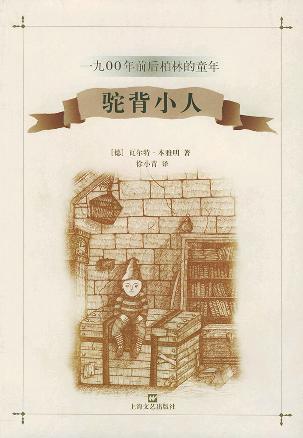
Benjamin’s Humpty Dumpty: Childhood in Berlin Around 1900

Third, student sports and "learning as sports"

Bai Yongrui:After I went to college, I became interested in the structural problems of Korean society and joined a group aimed at cultivating social activists. Although the ideological interest group I joined had some connection with the student movement, what was more urgent at that time was the "October Reform" incident in Korea in October 1972. That is, President park chung-hee will change the constitution to realize the lifelong presidential system. Revise the constitution, formulate the "Reform Constitution" and move towards dictatorship. This happened in my freshman year. I went to school that morning, and the chariot was parked in front of the gate. The soldiers took control of the gate and drove the students out of the campus. Then, the university entered a state of long-term suspension. People can’t vote for the president directly, which runs counter to the democracy I learned in middle school and university. I can’t forgive the government’s behavior. This has also become an opportunity for me to directly participate in the student movement. The discussion about history study mentioned just now, for me, the influence from the ideological interest group far exceeds the formal university classroom, and its influence has continued to this day. As my own view of learning, I practice "learning as a sport". This is also directly related to the current research.

Tsukagoshi Hirotaka Nakajima:I want to confirm the date. President park chung-hee promulgated the National Education Charter in 1968. At that time, Professor Bai was still a high school student, right?

Bai Yongrui:Grade three.

Tsukagoshi Hirotaka Nakajima:Professor Bai just mentioned that when you go to school, you can choose French as a second foreign language besides German. Is this a system reform because of the promulgation of the National Education Charter?

Bai Yongrui:There may be other reasons for adding two foreign languages. The important educational reform in 1968 was the beginning of military training in schools.

Tsukagoshi Hirotaka Nakajima:Dictatorships and similar regimes are bound to intervene in education and try to change it. The park chung-hee regime has completely intervened and changed this. You entered the university in March 1972, and the university was blocked six months later. How long did this blockade last?

Bai Yongrui:Five months.

Tsukagoshi Hirotaka Nakajima:What happened in the meantime?

Bai Yongrui:Let’s talk about how the Reform Constitution elected the president. First of all, the "National Assembly of the Unified Subject" was established as the appointed body of sovereignty, and the president was indirectly elected through this meeting. Shortly after the October Reform, a meeting was held to elect a president. After that, various systems were improved by issuing presidential decrees. These things happened during the five months when the university was blocked. The regime established in the "Reform coup" became an orthodox regime, during which universities were closed. An exam was held in February, and the term ended.

Tsukagoshi Hirotaka Nakajima: You just said that when Nixon visited China in 1972, China and the United States started dialogue, and the situation in East Asia, including Japan, changed dramatically. As a history student, you should have thought a lot at that time, right?

Bai Yongrui:Let me explain the characteristics of the student movement at that time. The student movement at that time was not so much a political movement to change the system or play a certain political role as a large-scale cultural movement. Recently, some American scholars suggested that the student movement in South Korea in 1970s and 1980s created a "Counter Public Sphere". Let’s not talk about whether we should use this term, but our goal at that time was to build a popular national culture as an alternative to the orthodox culture of nationalism. Participating in the construction of alternative culture is the common value of activists. The main reason why the student movement can last until the 1980s is not only that it is a political movement, but also that it wants to create alternative culture in all fields of social life, and this conceit is the spirit of the student movement.

Tsukagoshi Hirotaka Nakajima:Since the beginning of the increasingly powerful reform system, you have spent this time as a college student.

Bai Yongrui:In April 1974, a large-scale demonstration took place in South Korea. This is a national parade led by college students. The authorities announced that the "All-China Federation of Democratic Young Students" led the March and attempted to create civil strife. They arrested the student leaders, and I was one of them. The All-China Federation of Democratic Young Students is referred to as the "Youth League". In fact, the Youth League of China is not a systematic organization. However, the authorities believe that this is an organization instructed by North Korea to act in a unified manner in an attempt to launch civil strife. I don’t have any officially appointed position, just a parade liaison in Seoul National University.

In the end, I was arrested as one of the masterminds of the civil strife. That parade happened just during the emergency measures taken according to the Reform Constitution, and the whole trial turned into a military trial. I was sentenced to seven years in prison and expelled from the university. At that time, the newspaper reported the Youth League as a criminal organization and attached a grass-roots organization chart. I’m in there, too. They said that behind this "criminal organization" was an organization called the People’s Revolutionary Party, in which spies instructed by North Korea attempted to launch a revolution, including Japanese independent journalists. In fact, the "People’s Revolutionary Party Incident" is part of a large-scale civil strife conspiracy fabricated incident. Later, when Roh Moo-hyun was in power, the case was retried. The court ruled that this was a fabricated event without any factual basis. In 2013, I was acquitted in the final trial, and seven years’ imprisonment was invalid. I was officially rehabilitated.

Tsukagoshi Hirotaka Nakajima:It took nearly forty years.

Bai Yongrui:If you look at my resume, you will find that I seem to have studied in college for nearly nine years. In fact, from 1974 to the end of 1979, I was counted as a "student without citizenship". After the death of President park chung-hee, I was able to resume my studies in March 1980 and then graduated.

Tsukagoshi Hirotaka Nakajima:Before, I went to Jeju with Professor Bai. The "Jeju Island April 3rd Incident" in 1948 was also considered to have North Korea behind the scenes, and many people were killed. Such fabrications keep happening. Just now, you said that there were Japanese independent journalists in the People’s Revolutionary Party incident. What was the connection between the student movements in Korea and Japan at that time?

Bai Yongrui:I don’t think there is a direct connection between the two. Although Japanese and Koreans can bring Japanese books when they study in Korea, it is by no means easy and can easily be regarded as spies. Due to the situation at that time, everyone could not keep in touch with the outside world. After reading the works of the famous brothers Xu Sheng and Xu Jingzhi, you will know that it was a difficult time.

Tsukagoshi Hirotaka Nakajima:The reason why I asked the question just now is because the student movement in Japan was at the end in 1983 when I entered the university, and everyone received a lot of news about the Korean student movement. Therefore, in my impression, students who participated in the Japanese student movement also participated in the Korean student movement, and there is a connection between the student movements in Japan and South Korea. But you just said that it would be regarded as a spy, which seems very difficult!

Fourth, reading life in prison

Tsukagoshi Hirotaka Nakajima:What books did you read in prison? What thoughts have you made?

Bai Yongrui:Although he was sentenced to seven years, the actual detention period was ten months and fifteen days. When I was in prison, my mother took part in the democratization movement. At that time, the democratization movement of the whole society was in full swing. The authorities were forced to make concessions and suspended my sentence. He was released from prison in February 1975. Although I stopped serving my sentence, I was not acquitted, so I could not return to school. Just like parole, you can’t go back to college, and you can’t walk around at will.

There are two books that are very important to my prison life. One is Taijun Takeda’s Sima Qian. After reading this book, I was deeply moved by Sima Qian’s spirit of writing history in a difficult situation. When I read that he was still recording history in prison after being tortured, I couldn’t help crying.

Another book is Li Yongxi’s The Theory of Changing Times, which is the fourth in a series of new books published by the Creation and Criticism Society. This book was lent to me by my cellmate Lee Hae Chan, who later became the prime minister of Roh Moo-hyun’s government. When he lent me a book, he said that after reading this book, you will have a new understanding of the China Revolution and the Vietnam War. Therefore, I take it for granted that this is a Japanese book, and I never thought that there would be such works in Korean books. I secretly got it in prison and found that it was actually a Korean book. There are new ideas about the "Cultural Revolution" in the book, and there are many new understandings of the history of China, including the "Cultural Revolution", which deeply shocked me after reading it. This book has refreshed my understanding of the history of China. It was not the class at Seoul National University that prompted me to revisit the study of China’s history, but the book The Theory of Changing Times that I read in prison.

Except me, all young Koreans in the 1970s were deeply influenced by this book. Including the late President Roh Moo-hyun, this book had an absolute influence on the young people at that time, so Li Yongxi was called "the mentor of the times". From the present point of view, you will feel that he is over-beautifying the "Cultural Revolution" and the Vietnam War. But at that time, during the period of capitalist development after rapid economic growth, various problems emerged in Korean society. This book provided us with a mirror to reflect on reality and understand ourselves. This is the meaning of this book. In short, The Theory of Changing Times is like putting a mirror outside us, so that everyone can reflect on themselves. In this sense, this book, as a weapon to criticize Korean society, has achieved remarkable results. Even now, we should acknowledge its value.

Li Yongxi later wrote Idol and Reason. This title simply and clearly summarizes the mental state of Korean society at that time. ……

In the situation in East Asia at that time, the atmosphere of reconciliation and relaxation policies between China and the United States swept across the country. In such an international situation, the key word "transformation" was generally accepted by Korean society at that time. If we regard this era as an era of transformation, we need new theories that conform to this era. Idol and Reason is a work that meets this requirement. Therefore, Li Yongxi’s works were accepted by many young people at that time.

Tsukagoshi Hirotaka Nakajima:This is "learning as a sport".

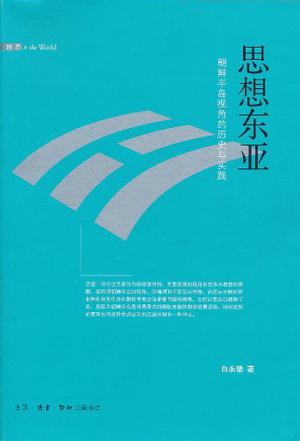
Bai Yongrui’s Thoughts of East Asia

V. Changing society through language

Bai Yongrui:After I got out of prison, I was in a state of nothing to do. Criminal police often followed, and the general environment at that time was that the participants in the student movement either engaged in political activities in the wild, or worked in factories under cover, and then formed trade unions to carry out labor movements. These are the ways for people who are interested in the revolutionary movement, but I can’t do it. Later, I became an editor in a publishing house. This publishing house is the "Creation and Criticism Society" that is still related to me (its name was changed to "Chuangpi" in 2003).

Shortly after I got out of prison, I visited teacher Li Yongxi’s home. I admire Teacher Li very much. We read and discussed together, from literature to the revolutionary history of China. At the same time, as an editor, I work with books. Because of some trauma in my mind, or some feeling I have had since childhood, and I like reading and writing, I began to realize that it is my duty to change society through language through editing this job.

Of course, the reason why I think of changing society through language is also related to my personal habits and growing experience. But the most important thing is that I do feel the reform power of language. What impressed me the most was after returning to the university campus in the spring of 1980. At that time, the university wall was covered with posters, on which students quoted Mr. Li Yongxi’s words and extracted sentences from books and magazines published by my creative and critical society, showing the demand for social change. Seeing this, I deeply feel the power of language and how important it is to elaborate ideas.

Tsukagoshi Hirotaka Nakajima:You can feel the vitality of language by quoting the ideas in the books of Teacher Li Yongxi and the Creation and Criticism Society. When I was in college, there were also vertical billboards and posters on campus, but the words on them made people feel old and lifeless. I passed the end of the student movement in Japan, which was completely different from Professor Bai’s experience.

After resuming your studies, you graduated from undergraduate course in August 1981. In March of the following year, I entered the Graduate School of Tankook University (Korean schools graduated in August and entered in March). At that time, many partners who participated in the student movement and colleagues in the creative and critical society were outside the university campus. Who did you mainly act with?

Bai Yongrui:First of all, Lee Hae Chan mentioned just now, and Jin Zhihe, a poet who served his sentence together. Immediately after I got out of prison, I went to see Mr. Li Yongxi and studied the revolutionary history of China with him. Jin Zhihe told me that you shouldn’t be a political athlete or a labor athlete, you should be a scholar. He also said that Teacher Li Yongxi viewed the China issue from a journalist’s point of view. As a scholar, you can study the history of China as an ideological issue or a historical issue, which is exactly what you need now, and this is also your duty.

Six, from the history centered on human history to social humanities.

Tsukagoshi Hirotaka Nakajima:Just talking about Taijun Takeda’s Sima Qian, China’s historiography pays attention to exploring the changes of the times and its reasons, which is different from the emphasis of modern historiography. The history you want to learn from Mr. Li Yongxi is about the historical structure of the China Revolution, but it seems to be a combination of traditional China historiography and modern historiography to discuss how this structure came into being and how it changed.

Bai Yongrui:Professor Nakajima’s comments are very interesting. So far, I haven’t thought deeply about this problem. Now I can explain my thoughts.

Modern historiography expounds history with the system and structure as the center, but China’s viewpoints and narratives focus on people. I think we should find a narrative way that can transcend these two historiography. Therefore, we should focus on "people" first. However, this does not refer to a famous person or related historical stories of China, let alone modern historiography which focuses on system and structure. What I am concerned about is not the "people" themselves, but the relationship between those who live in the system and the structure. This is "history centered on human history". I wonder if I answered your question just now. How to develop history centered on human history is my current research topic.

Tsukagoshi Hirotaka Nakajima:There are also historians like Naito Hunan. Naito’s stories are large in scale, which makes people understand the reasons for the rise and fall of traditional China’s rebellion, but in the end, it encourages the contempt for China at that time. Naito tried to combine the discussion of system and structure in modern historiography with China’s traditional historical narrative in some way, but eventually he lost his critical consciousness of the Japanese status quo.

Compared with Naito’s practice, Professor Bai wants to develop the two methods as two intersecting lines, which is exactly the opposite. In other words, your approach is neither to focus on the characters in China’s rebellion, nor to focus on the system and structure but make the characters disappear from history, as in modern western historiography. Therefore, Professor Bai’s article not only pays attention to human history, making it appear repeatedly, but also has a critical consciousness of the present situation.

Bai Yongrui:I am very grateful to Professor Nakajima for evaluating my research work from that perspective. You said that my research method is completely opposite to that of Naito Hunan, and I was really scared. In any case, Professor Nakajima did point out the direction of future historical research with a novel point of view.

No matter what changes and twists and turns occur in history, history must focus on human history. For me, this is the most important thing. The reason why I regard human history as the main content of historical research is not only because I have paid attention to literature since I was a child, but also because of my later creative activities in the quarterly journal of literary politics, Creation and Criticism, and the Creation and Criticism Society. Creation and Criticism is a comprehensive magazine that involves and intervenes in social movements and the current situation. It has exercised my sensitivity as an editor and a reporter. Later, how to construct and expound the history centered on human history became my main research topic. From this point of view, the crisis of "history as a system" and "history as an academic" is precisely a result of these historical studies ignoring human history. Therefore, in order to get rid of the "institutional" history that caused this crisis and result, I have always emphasized "history as empathy".

Tsukagoshi Hirotaka Nakajima:I’d like to ask Professor Bai again about the relationship between "academic" history. Excuse me, what was written in the graduation thesis of this master’s period?

Bai Yongrui:The undergraduate thesis is about Liang Shuming’s rural construction movement. My master’s thesis originally wanted to write about the May 4th Movement or the Communist Movement, but Mr. Min Douji suggested that, based on your experience, if you do research on the Communist Movement or Radicalism, it is not conducive to finding a job in the university in the future. On the contrary, you should study the Kuomintang movement, which is considered a "reactionary" even in China. Therefore, the master’s thesis wrote Zhu Zhixin, the left wing of the Kuomintang.

Tsukagoshi Hirotaka Nakajima:I see. My master’s thesis was written by Zhu Zhixin, and later I did research on Dai Jitao who put forward the theory of national revolution.

Bai Yongrui:Zhu Zhixin was also one of the propagandists of Marxism, so he was studied in his master’s thesis. As for Dai Jitao, Japanese Sun Wen Studies introduced my Dai Jitao studies.

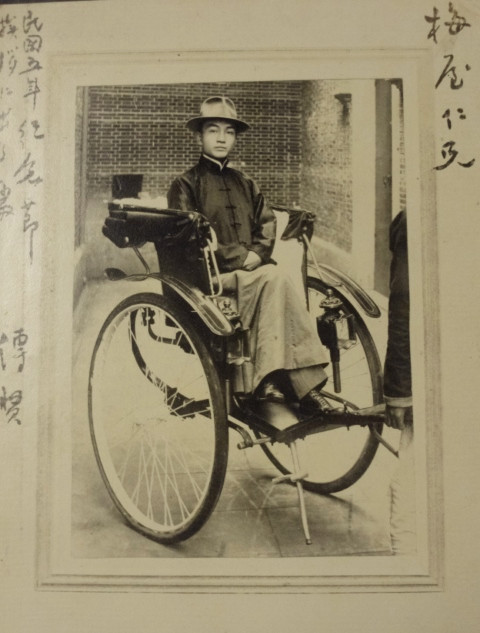
Photo taken on Dai Jitao’s rickshaw (taken in Tokyo in 1916). At the top left of the photo, it says "When I went to greet before the 5 th anniversary of the Republic of China". Hidden in the Meiwu Zhuangji Reference Room.

Tsukagoshi Hirotaka Nakajima:Have you been studying with Mr. Min Douji since you were an undergraduate at Seoul National University?

Bai Yongrui:Teacher Min Douji’s influence on me only became greater after the 1980s.

Tsukagoshi Hirotaka Nakajima:I see. I thought you and Mr. Min Douji knew each other for a long time.

Bai Yongrui:After I got out of prison, I went back to the university campus first. After entering the graduate school, I entered the door of teacher Min Douji.

Tsukagoshi Hirotaka Nakajima:When you first entered Seoul National University, wasn’t Mr. Min Douji there?

Bai Yongrui:When I entered school, Mr. Min Douji was already a teacher at Seoul National University, but he went to Germany for academic leave. Moreover, I have only taken one class, and there is no intersection with Mr. Min.

Tsukagoshi Hirotaka Nakajima:Just now you mentioned that positivism prevailed in the history department, and Mr. Min Douji was not one of them.

Bai Yongrui:In fact, there was another thing that happened. When I submitted my application for admission to the Graduate School of Seoul National University, I was told that I was not qualified for admission. At that time, Mr. Min Douji was very angry with the university’s decision and said that "it is impossible to be unqualified, what is going on". He told me that even if I failed, I could go to the exam first. In the end, I didn’t get into the graduate school of Seoul National University.

Tsukagoshi Hirotaka Nakajima:Therefore, you went to the Graduate School of Tankuo University.

Bai Yongrui:Although I entered the master’s program in the Graduate School of Tankuo University, I received personal guidance from teacher Min Douji for three semesters. This is not a formal research class, but one-on-one personal guidance, including the history of China’s philosophy, the history of Chinese historiography and thesis guidance. After entering the late period of Quan Douhuan’s regime, the social restrictions on former student movement participants were reduced. Unlike when I took the master’s degree, I was able to enroll in the doctoral program of the graduate school of Seoul National University. So, I returned to Seoul National University.

Tsukagoshi Hirotaka Nakajima:So, once again, you are under the door of Mr. Min Douji. What kind of person is Teacher Min Douji?

Bai Yongrui:I once compared the academic achievements of Mr. Min Douji and Mr. Li Yongxi in a critical study of China. For me personally, both of them exist in my heart like prosecutors. Teacher Li Yongxi may ask, can your article become a weapon of social change? Teacher Min Douji may ask, is your article writing based on strict academic norms? I often ask myself these two questions when writing articles.

In addition to South Korea, Mr. Min Douji is also a famous positivist in Japanese societies. But I have been in close contact with him and feel that he is not just a positivist. It is often said that Mr. Min Douji, as a liberal, did not take part in the action to change reality. Although Mr. Min Douji is not directly involved, he will severely criticize the real problems in his essays and other places. In fact, before I took part in the student movement, I had a meeting with Mr. Min Douji once during my undergraduate course. At that time, I wanted to study history and take part in political movements, and I didn’t know which way to choose. So I confessed my troubles to Mr. Min Douji. Now, I have also become a university professor. When students ask such questions, I always find it difficult to answer them. At that time, as a student, I asked this question to Mr. Min Douji. Teacher Min Douji suggested that I should strictly distinguish between "words and deeds as a citizen" and "words and deeds as a scholar", and recommended Max Weber’s "Learning as a Career". I opened the book with great expectation, expecting to read an exciting article, but Weber was throwing cold water on it and the content was serious. I gave up before I finished reading, and was later arrested and imprisoned for participating in the student movement. At that time, what bothered me was how to combine "learning as a system" with "learning as a movement", and how to distinguish and combine "words and deeds as a citizen" and "words and deeds as a scholar" that Teacher Min Douji said. Today, I am still looking for these answers.

Some people who know my relationship with Mr. Min Douji will wonder why people like Mr. Min Douji tolerate people like me who are keen on real politics and have been arrested and imprisoned for participating in the student movement. In this regard, I want to say at first that Mr. Min Douji is not only a positivist, but also a magnanimous person who can tolerate people like me. Dare not talk about the teacher’s private affairs, just say one thing. Teacher Min Douji was born in Jeolla-do, which was once a fierce guerrilla battlefield during the Korean War. Mr. Min Douji had a predecessor who died in guerrilla warfare. This predecessor was intelligent and eager to learn, and he was excellent. Before he took part in guerrilla warfare, he told Mr. Min Douji: I entered the war for the sake of righteousness. Although I can’t continue my studies, you must continue reading. The elder entrusted his full ambition to Mr. Min Douji, and Mr. Min Douji kept this agreement.
Tsukagoshi Hirotaka Nakajima:What a great teacher! At that time, you were studying under Mr. Min Douji, and at the same time, your intersection with the real society, especially with Creation and Criticism, was deepening. Through publishing work, contact with the society in different forms with student movements. Under Mr. Min Douji, your research has become more rigorous. These are things that Professor Bai grasped with both hands at that time. Excuse me, how do you promote knowledge research and social activities at the same time

Bai Yongrui:I’m still worrying about this problem. How to combine both at the same time? This is not only my personal problem, but also a problem related to my own research theme "academic history research" In other words, research is carried out around "learning as a movement" and "learning as a system", in which we objectively think about our identity. In this sense, the Japanese version of my book contains two articles that I like very much. One is The Birth and Decline of Oriental History, and the other is A Critical Study of China. I want to do some research on Korean studies and Japanese studies from this perspective as much as possible in the future.

Whether it is academic research or social activities, I am carrying on with these troubles. Before that, he served as the dean of the National Studies Institute of Yonsei University for seven years, and established HK(Humanities Korea, the national research project of Korea "Humanities Korea") with "Social Humanities" as the research theme. During these years, my colleagues and I have been thinking about how to combine "learning as a system" with "learning as a sport".

Whether we use the terms "learning as a sport", "learning as a system" and "social humanities" or not, we do meet companions who share the same values and think together everywhere. In the future, I want to move the main venue of the activity to the creation and criticism society outside the university, so that the social humanities can continue to carry forward.

Tsukagoshi Hirotaka Nakajima:From the beginning as an editor, Professor Bai has always had an intersection with the Creation and Criticism Society. Recently, you have become the main member, and your relationship with the agency has gone further. Excuse me, what is your relationship with Mr. Bai Leqing, editor-in-chief of Creation and Criticism?

Bai Yongrui:Because there are very few people with the surname "Bai" in Korea, some people speculate whether there is a blood relationship between me and teacher Bai Leqing. Actually, we are not related. Because of teacher Li Yongxi, I got to know teacher Bai Leqing. Teacher Li Yongxi was sued for "The Theory of Changing Times" and "Idol and Reason". As a publisher, Creative and Criticism Society made teacher Bai Leqing a "joint principal offender", but he was not arrested and put on record, but helped teacher Li Yongxi to join the lawsuit. So, I naturally got to know Mr. Bai Leqing.

At first, I worked as an editor in the Creation and Criticism Society, and later I participated in publishing as a graduate student and a university professor, which lasted for 30 years. I often think about my role in the creative and critical society. As an editor, an editorial board member and an editor’s main force, I have spent these thirty years.

I have reached the age of hearing. Looking back, my friends and colleagues who participated in the student movement all entered the field of political or social movements, while I, as a university professor and editor, have been dealing with books. For me, this kind of life choice is very consistent with my own endowment and meaningful. I am really lucky to be able to produce knowledge as a professor and a researcher, and at the same time to spread knowledge as an editor. Compared with the career as a scholar, the career as an editor is longer. From now on, I want to continue to work hard to do these two jobs.

How to open the No.1 spare parts warehouse for the safe operation of Yuanshen 4.1? A list of the safe operation of No.1 position.

The safe operation of Merlot Peter’s life scene needs to open the communication channel through the No.1 spare parts warehouse. Players need to find the pointer compass mechanism in the middle of the operation, and stop the operation when the pointer points to the lower right, and then open the front channel to the next task point.

How to open the No.1 spare parts warehouse for the safe operation of Yuanshen 4.1

First, the safe operation of Merlot Peter’s life scene No.1 position

1. First, track the task to the task point in the abandoned production area on the 6th floor. If the anchor point on the 5th floor has not been opened, jump down from the front of the anchor point on the 2nd floor and take the elevator to the 5th floor.

2. After reaching the task point above, the tracking task comes to the pointer compass mechanism in the middle here below, whenWhen the pointer points to the lower right, [Stop Running], you can open the front channel to the next task point.

3, before going to the next task point, first from the pointer compass here.[Remove 1 gear driver], and then install 【 gear driver 】 in the position shown below, and then 【 run 】 the pointer mechanism here as a pointer.When pointing straight ahead, [Stop running], you can open the front channel.

4. Then come to the position shown below. After the story is over, the task [Merlot Peter Life Scene Safety Operation] is over, and then the task treasure box is opened, just to get [300 privileged volumes], and then you can continue to do the task [Rich Game].

5. Tracking Mission [Regal Game] After going to the [old place] for the plot, take a nap. Later, after coming to this [old place] for a nap, start the next stage to earn [franchise volume].

6. After sleeping in the [old place], we can start the task of obtaining the [300 Licensed Volumes] for the second time. In the same way, we should suspend the task of [Rich Game] to earn the [Licensed Volumes]. This time, we need to finish the task [Merlot Peter’s life scene, this road is blocked] and the task [Merlot Peter’s life scene, bad business] first.

Ada photo tidbits exposure girl feels full of bee waist and hips.

Ada’s skin is as transparent as a girl.

Ada’s skin is as transparent as a girl.

Ada’s skin is as transparent as a girl.


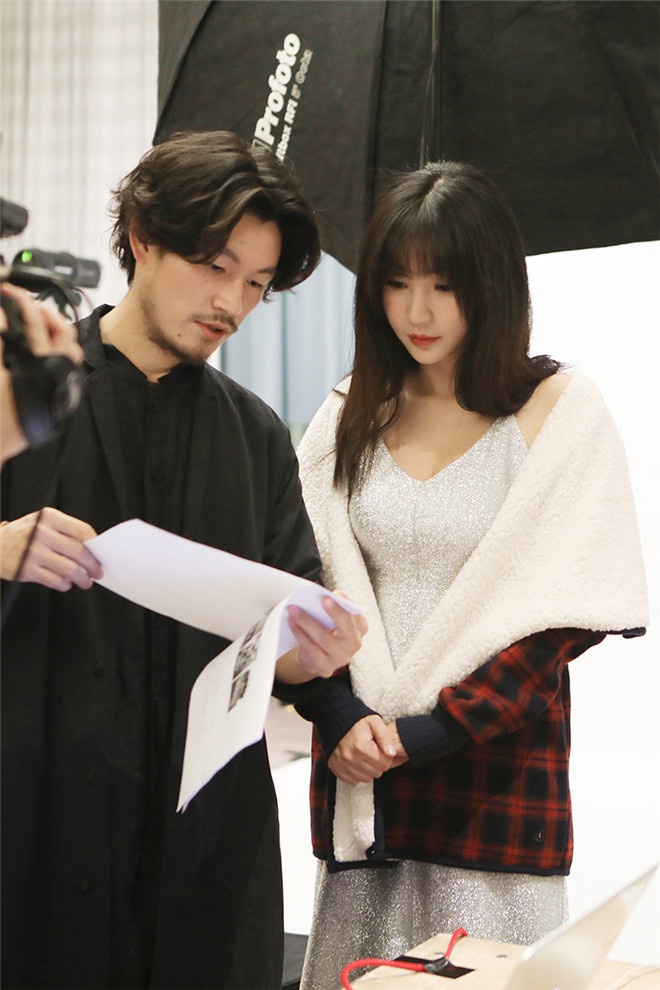
1905 movie network news On May 10th, a group of studios in Ada took photos of the highlights. In the photos, Ada’s black straight hair was soft and drooping, the air bangs were fashionable and the age was reduced, the long silver earrings modified the face, the silver suspender dress was more transparent and white, the red lips were bright and long, the hair was fluttering, the temperament was bright and moving, and the career line was eye-catching. In the tidbits, Ada also listened carefully to the photographer’s explanation of the shooting script, quiet and earnest, and full of intimacy.


Ada listened carefully to the photographer explaining the shooting script.

Ada silver dress with suspenders is fresh and elegant.

Ada silver dress with suspenders is fresh and elegant.

It is reported that Ada’s partner Li Rui, Liu Genghong and Li Chuan’s brand-new variety show "Enjoy Beauty" premiered today. Among them, Ada is not only the only female guest, but also has different forms of cooperation with three male guests. As the representative of the Almighty Goddess, she has put forward many views representing women’s positions for amateur players, with frequent golden sentences and online business. In terms of film and television works, Ada co-starred with Qin Hao, Cai Guoqing, Wang Terry and Bao Wenjing, and it was scheduled to be released nationwide on July 13th in the summer vacation. This film was adapted from the best-selling juvenile adventure series novel created by Leo Phantom, and it was the first juvenile fantasy adventure film in China. Ada owned his own pub in it, so he must be a wise and independent woman. The films from Wang Leehom, Victoria Song, Godfrey Tsao, Wu Qianyu, Gao Shengyuan, Chilam, Li Yuan and Wu Jiacheng are also expected to meet with you this year. In addition, Ada also starred in the two TV series "Wu Dong Gan Kun" and "Back to the Ming Dynasty as a Prince Yang Ling Biography". In the TV series "Wu Dong Gan Kun" which will land on Hunan Satellite TV in the summer, Ada plays the glamorous but hidden villain "Mu Qianqian". In the Biography of Yang Ling, who was co-starred by Ada’s partners Jiang Jinfu, Crystal and Wayne, she was incarnated as "Cheng Qiyun" with both civil and military skills, and her double charm attracted a lot of attention.


The Ministry of Education issued the early warning information of the 2022 college entrance examination to remind the majority of candidates to be vigilant and beware of being deceived.

  College entrance examination is a big test in the life of college students, which is related to the vital interests of candidates and has attracted much attention from the society. With the approach of the college entrance examination in 2022, the majority of candidates have entered the final sprint stage, and some lawless elements have also used the college entrance examination to spread false information, create anxiety, cheat and even induce candidates to cheat in the exam. To this end, the Ministry of Education, in conjunction with the Central Network Information Office, the Ministry of Public Security and other departments, combined with some typical cases in recent years, solemnly reminded the majority of candidates and parents to be vigilant and beware of being deceived.

  1. Organizing cheating in the college entrance examination is a serious violation of the law.

  During the college entrance examination, criminals often post "exam-helping" information online, claiming that they can provide exam questions and answers for candidates. As everyone knows, it is a serious crime to organize candidates to cheat in national education examinations such as the college entrance examination, provide candidates with test questions and answers, and sell and use wireless cheating equipment.

  [Case] During the college entrance examination in 2019, He Mohao, a college student, posted an advertisement for "Assisting Exam" on the Internet, and 12 candidates from Guangdong, Shandong and Guizhou paid the "registration fee" to him. He Mohao contacted college students Nie Mouwu and Peng Molin (He Mohao’s classmate) on the Internet, and the three worked together. He Mohao was responsible for contacting and passing the test questions and solving the answers, Nie Mouwu was responsible for solving the problems, and Peng Molin was responsible for sorting out the test questions, cheating for 12 candidates during the college entrance examination. On June 8, the police acted immediately after receiving the clue and arrested He Mohao, Nie Mouwu and Peng Molin on the spot. Three people were sentenced to two to three years and six months in prison for cheating in organizing exams.

  【 Regulations 】 The Criminal Law of People’s Republic of China (PRC) clearly stipulates that it is illegal to organize cheating, sell or use wireless cheating equipment, provide test questions and answers to candidates, or let others take the exam instead of themselves in the national examination prescribed by law. The Interpretation of the Supreme People’s Court and the Supreme People’s Procuratorate on Several Issues Concerning the Application of Laws in Handling Criminal Cases such as Cheating in Organizing Examinations makes it clear that those who cheat in national education examinations such as college entrance examinations and postgraduate examinations will be directly identified as "serious" acts, and will be sentenced to fixed-term imprisonment of not less than three years but not more than seven years and fined.

  [Reminder] In recent years, local public security organs, together with the education departments, have continued to maintain a high-pressure crackdown on all kinds of illegal and criminal activities involving exams, with "zero tolerance". The majority of candidates must enhance their legal awareness, refuse to cheat in exams, and don’t try the law.

  Second, taking the test is not a shortcut, but a "desperate situation"

  In order to get their children into an ideal university, some parents try their best to find a "way" for their children and even find a "gunman" to take the exam for their children. As a result, people and money are empty, and the consequences are very serious.

  [Case] In order to let his nephew Xiao Chen, who has poor academic performance, be admitted to the undergraduate course, Li and Xiao Chen’s mother discussed and decided to spend money to find someone to take the exam for Xiao Chen, and promised to give 50,000 yuan for being admitted to "one book". In the end, Liu, a graduate student in a school, promised to take the test for Xiao Chen. Results On the day of the college entrance examination in 2019, Liu was discovered by invigilators on the spot. The police immediately filed an investigation, and the people involved arrived in the case one after another. Li organized candidates to cheat, which constituted the crime of cheating in organizing exams. He was sentenced to three years in prison and fined 30,000 yuan. "Gunner" Liu took the test instead of others, which constituted the crime of taking the test instead; Parents of students who let others take the exam instead of their children also constitute the crime of taking the exam instead. They were sentenced to five months’ criminal detention and fined 4,000 yuan to 10,000 yuan respectively.

  【 Regulations 】 The Criminal Law of People’s Republic of China (PRC) clearly stipulates that it is illegal to "organize cheating" or "substitute others or let others take the exam instead of themselves" in the national examination prescribed by law. Moreover, the crime of substituting for examination is a typical opposite crime. The criminal law punishes both the examinee and the gunman, and the conviction and legal punishment are the same.

  [Reminder] Parents who help their children cheat are not loving their children, but harming them. In the end, they will have to bear legal responsibility. Liu, a graduate student, acts as ‘ for tens of thousands of yuan of substitute exam fees; Gunner ’ , ruined his bright future. The majority of candidates and parents should fully understand the harm and legal consequences of taking the test, and take the test in good faith, otherwise they will suffer the consequences.

  Third, I am lucky to bring my mobile phone, and cheating in the exam will ruin my future.

  Nowadays, the use of smart phones is very common, and some candidates often use smart phones to search questions, translate and other functions to assist learning and improve efficiency. However, if you cheat with your mobile phone in the exam, you have miscalculated your abacus, and you are smarter than you are.

  [Case] During the college entrance examination in 2021, a candidate illegally carried a mobile phone to avoid the entrance security check and brought the mobile phone into the examination room. During the examination, the student used his mobile phone to sneak shots of the test questions and sent them to the off-site for answers, which was seized on the spot. According to the Measures for Handling Violations in National Education Examinations, the student was punished with disqualification, and all his grades were invalid, and he was stopped from taking national education examinations.

  [Regulations] The college entrance examination is a national education examination prescribed by law. The Measures for Handling Violation of National Education Examination clearly stipulates that anyone who uses communication equipment during the examination shall be deemed as cheating in the examination, and his scores in all subjects registered for the examination at that time shall be invalid. The Education Law of the People’s Republic of China clearly stipulates that candidates who carry or use cheating equipment and materials in national education examinations, if the circumstances are serious, shall be ordered by the education administrative department to stop taking the relevant national education examinations for more than one year and less than three years; If it constitutes a violation of public security administration, it shall be punished by the public security organ according to law; If a crime is constituted, criminal responsibility shall be investigated according to law.

  [Reminder] In order to prevent and crack down on cheating on mobile phones in national education examinations and further strengthen the comprehensive management of the examination environment, in 2022, the Ministry of Education, the Ministry of Public Security and the Ministry of Industry and Information Technology jointly deployed local education, public security, communications, radio management and other departments to take a number of measures to carry out the special treatment of "cracking down on cheating on mobile phones". The majority of candidates must know the law and abide by the law, take the exam in good faith, and don’t take chances, so as not to ruin their future.

  Fourth, look for the official logo and don’t believe "gossip"

  Every year before the exam, there will be a lot of information about the exam on the internet, and all kinds of information are mixed. In order to attract attention, some individuals or training institutions take the opportunity to register "shanzhai" public accounts and spread "gossip" from unofficial sources to seek benefits.

  [Case] The college entrance examination in 2020 was postponed for one month due to the epidemic. From time to time, there are so-called college entrance examination arrangement information from the media on the Internet. For example, there are false news about "the arrangement of the examination room in a city in 2020" from the media, which misleads the public and causes anxiety among candidates and parents. According to the city’s education bureau, the news is false information.

  【 Regulations 】 According to the Regulations on the Administration of Internet User Account Names and the Regulations on the Administration of Internet User Public Account Information Services of the Central Network Information Office, the Internet user account names registered and used by any institution or individual shall not spread rumors, disrupt social order and undermine social stability; Public account producers and operators shall not maliciously counterfeit, counterfeit or embezzle the public accounts of organizations and others to produce and publish information, and shall not fabricate false information, distort the truth and mislead the public. Those who violate laws and regulations will be severely dealt with according to the law.

  [Reminder] In 2022, the Ministry of Education, together with the Internet, the public security department and a number of Internet companies, will continue to carry out the special action of "lighting the official website logo of the authoritative examination enrollment institution" and "cleaning up the public accounts involved in the Internet examination", so that the majority of candidates and parents can timely, comprehensively and accurately understand the college entrance examination information of authoritative institutions and avoid being deceived. When the majority of candidates and parents search for information about the college entrance examination online, please look for the "official" logo of the authority (such as,) and beware of fake accounts or website scams.

  Five, don’t believe false propaganda, beware of being deceived.

  Exam "guaranteed", double promotion, XX days crash, or exclusive "internal resources", "proposition experts" to teach, to ensure "one-time pass" and so on … … Such slogans and enrollment advertisements often appear in the enrollment propaganda of various examination and training institutions, which makes many parents believe it. In fact, there are violations of laws and regulations such as exaggerating propaganda, fictional teachers, price fraud and false advertisements to varying degrees.

  【 Regulations 】 The Advertising Law of People’s Republic of China (PRC) clearly stipulates that advertisements for education and training shall not contain the following contents: (1) Make an express or implied guarantee commitment to entering a higher school, passing an examination, obtaining a degree or a certificate of qualification, or to the effect of education and training; (two) express or implied that the relevant examination institutions or their staff and examination proposition personnel participate in education and training; (3) Using the names or images of scientific research institutions, academic institutions, educational institutions, trade associations, professionals and beneficiaries for recommendation and certification.

  [Reminder] Candidates and parents should not believe in false advertising, which will not only cause property losses, but also delay valuable review time.

  Sixth, online fraud should be identified, and the answer to the college entrance examination cannot be purchased.

  Every year, criminals peddle so-called "college entrance examination questions" and "top secret answers" on online platforms or communication groups, flaunt seductive information such as "extremely high accuracy" and "default refund", and ask users to pay in advance in the name of "advance deposit". Others send viruses to users’ computers or mobile phones in the name of transmitting "sample test papers" to obtain user information.

  [Case] In March, 2021, Huang entered several chat groups through QQ, falsely claiming that he had channels to buy answers to the college entrance examination, and sold the so-called "answers to the college entrance examination papers" to parents and candidates at a price of 15,000 yuan per subject, defrauding more than 10 people in five provinces, including Anhui, Shandong and Hunan, and defrauding more than 100,000 yuan. At present, Huang has been criminally detained by the police according to law, and the case is under further investigation.

  【 Regulations 】 The Criminal Law of People’s Republic of China (PRC) clearly stipulates that it is illegal to "illegally sell or provide questions and answers to others for the purpose of cheating in the national examinations prescribed by law".

  [Reminder] The college entrance examination questions belong to the national top secret materials, and their storage and transportation have extremely strict management measures. The majority of candidates and parents must polish their eyes, distinguish between true and false, and beware of fraud!

The media said that 100 senior executives of FAW were investigated or experienced a major personnel exchange.

According to 21st century business herald, the reporter learned from authoritative sources that so far, more than 100 senior management members of FAW Group have been taken away by the task force to assist in the investigation, and tens of billions of funds have disappeared.

On the morning of the 2nd, the working meeting of the board of directors of China First Automobile Co., Ltd. was held, and seven people including Xu Jianyi formed the board of directors of FAW Co., Ltd. The seven members of the Board of Directors of FAW Co., Ltd. are Xu Jianyi, Xu Xianping, Sun Guowu, Song Ning, Leng Rongquan, Duan Yongkuan and Hao Yinfei. Among them, Xu Jianyi is the chairman of FAW, Xu Xianping is the director of FAW, Sun Guowu is the employee director of FAW, and the other four are external directors. Since the end of 2011, FAW Group has been caught in the audit storm of the National Audit Office due to the problem of power rent-seeking. Today, this case has been further fermented, and the cases in the case have been exposed one after another. Due to the impact of the FAW Wo case, the management of FAW Group may undergo a major change of blood, or it may experience the biggest personnel shock since the establishment of the factory in 1953.

The people who were taken away to assist in the investigation involved the relevant responsible persons of several subsidiaries and departments of FAW Group, with a large number of people and complicated cases, and some senior management members of subsidiaries were even taken away. These include Zhou Yongjiang, former general manager of FAW-Volkswagen Sales Co., Ltd. and deputy chief economist of FAW Group.

It is also revealed that the relevant departments have set up five joint task forces with different classifications in response to a series of recent major corruption cases, one of which is responsible for thoroughly investigating the FAW series of cases.

It is understood that the main investigation direction of the current task force is locked in the violation of FAW-Volkswagen and the upward trend of real estate funds of FAW Group.

The media said that 100 senior executives of FAW Group were taken away.

The media said that 100 senior executives of FAW Group were taken away.

More than 100 executives took away the investigation.

"Since last year’s audit storm, the investigators of the Commission for Discipline Inspection have been in and out of FAW Group, and people inside FAW are now worried. We don’t know who will be taken away tomorrow? " On April 9, a management person inside FAW-Volkswagen privately sighed to our reporter.

According to core sources, in the past month, more than 100 managers have been taken away by the task force to assist in the investigation, and many of them have been double-regulated, including Zhou Yongjiang, deputy chief economist of FAW.

At the height of the internal turmoil in FAW Group, many FAW executives booked air tickets to travel abroad, with only one purpose: to prove to the outside world that they had not been investigated by relevant departments.

"At this point, several senior executives in FAW have been notified to restrict going abroad, and the list of senior executives is obviously rarely known within FAW, so in order to prove their innocence, many senior executives chose to travel abroad." The source said.

The relevant case is significant and complicated. "There are tens of billions of funds unaccounted for, and now the financial clean-up work is underway, and some of them have been found to be misappropriated and embezzled."

According to this person, the fuse of the case of FAW Group was indeed due to the audit storm caused by the overall listing plan of FAW Group. "But this is also due to some conscientious senior employees and retired cadres of FAW System. Their previous reports laid some foundations for the investigation."

In the middle of last year, Jing Guosong, deputy general manager of FAW-Volkswagen Sales Company, was taken away by the discipline inspection department for investigation because of economic problems. The survey results show that Jing Guosong is involved in tens of millions of yuan. In addition, a person in charge of the large customer department of FAW-Volkswagen Sales Company committed suicide by jumping off a building at the same time.

"Jing Guosong’s investigation is likely to be related to FAW-Volkswagen’s internal handling of buyout resources." According to the reporter’s understanding, from 2007 to 2010, more than 170 non-commercial vehicles of FAW-Volkswagen were not recorded in time. The reporter confirmed from relevant departments that Jing Guosong’s investigation was closely related to one group of vehicles.

Real estate out of the case in the case.

In addition, the billions of unaccounted-for funds disclosed by sources are mainly concentrated in the real estate projects under the FAW Group. "This huge financial loophole has existed for many years, not overnight. Several insiders provided detailed reporting materials, which made a breakthrough in the investigation of the case. " The above-mentioned insiders said that at present, there are more than a dozen cases caused by the illegal operation of real estate in FAW, many of which belong to the case, involving a wide range of interests.

However, the insider refused to disclose the details of the real estate case of FAW Group.

At present, in addition to holding FAW Car and faw xiali, FAW also owns 13 enterprises, including faw liberation, FAW Volkswagen, FAW Jilin Automobile Co., Ltd., FAW Bus Co., Ltd., FAW Foundry, FAW Mould Manufacturing Co., Ltd., FAW Logistics Co., Ltd. and FAW Finance. Almost every enterprise has its own land resources.

The real estate projects of FAW Group also have considerable advantages in Changchun. According to local people in Changchun, almost half of the real estate projects in Changchun have the shadow of FAW, or participate in shares or develop directly.

However, FAW’s real estate project funds often disappear in the end.

"The relevant departments speculate that these assets involving the illegal operation of real estate development in disguised form of state-owned industrial land may fall into the hands of individuals, so several FAW executives are involved." The source said. Joint development with local real estate developers on the grounds of building factories and workshops. But it is puzzling that in the joint development, many projects have been "reincarnation" several times.

Deep water in FAW’s real estate business, as early as February this year, some media disclosed some clues.

It is reported that since 2006, Sichuan Mingjun Group has successively acquired three enterprises under FAW Group, namely FAW Chuanzhuan, FAW Hua Kai and FAW Hongding. The original sites of these three enterprises are located in the high-quality core area of the local main city. These enterprises have all moved or will move as a whole, and the original plots are used to develop high-end real estate projects.

For example, in December 2006, Mingjun Group, which had never set foot in the automobile industry before, injected 240 million yuan into FAW Chuanzhuan, a high-quality asset of FAW Group, by way of capital increase and share expansion. In the Spring Festival of 2009, FAW Chuanzhuan was moved out of its original site located in the core area of East Lake in the Second Ring Road of Chengdu, freeing up about 300 mu of land. Mingjun Group announced on its website that it will build a high-end urban complex integrating five-star hotels, Grade A office buildings, business and leisure areas, high-end quality houses and diversified financial and commercial clusters. The construction period of the project is 5 years, and the first phase is expected to open in 2013.

After that, FAW Hua Kai and FAW Hongding, which were also acquired by Mingjun Group, were both located in the main urban area of Changchun, with a land area of more than 200,000 square meters. The two factories have started the overall relocation, and the original land has now become the high-quality land reserve of Chengdu Zhonggang Real Estate, a real estate company owned by Mingjun.

It is reported that employees of FAW questioned Mingjun Group’s acquisition of FAW’s subsidiaries. In 2008, employees of FAW Hua Kai also expressed their opposition to the acquisition by Mingjun Group. They believe that Mingjun’s main business is real estate development, and the purpose of acquisition is not to promote the development of automobile enterprises, but to make money by acquiring real estate or reselling land. If they are acquired, the survival and development of these factories are insignificant to Mingjun Group, and the interests of factory employees will not be guaranteed.

In fact, during the relocation of FAW-Sichuan College led by Mingjun Group in 2009, there was a contradiction between Mingjun Group and some employees on the ownership of housing once allocated to employees, which led to the suspension of production. After the original FAW enterprises such as FAW Hua Kai were acquired by Mingjun Group, employees of the enterprise also visited the headquarters of FAW Group for many times because of treatment problems.

The people involved include Zhou Yongjiang, the former general manager of FAW-Volkswagen Sales Co., Ltd.

The people involved include Zhou Yongjiang, the former general manager of FAW-Volkswagen Sales Co., Ltd.

Changchun high-level officials frequently go to FAW to stabilize the army.

Drawing lessons from the case of FAW Wo, the case is of great importance and involves a wide range of personnel. Recently, senior party and government officials in Changchun, where FAW is located, frequently went to FAW to investigate and communicate with employees to stabilize the morale of FAW.

FAW is self-evident for Changchun politicians. According to the data learned by the reporter, from 1993 to 2010, FAW paid more than 190 billion yuan in national taxes, and its output value once accounted for half of Changchun City and more than one third of Jilin Province.

It can also be seen from Gao Guangbin, the current secretary of Changchun Municipal Party Committee, who has visited FAW for many times. On April 7th, Gao Guangbin waited for FAW headquarters to hold an on-site office meeting, which indicated that service and support for FAW should be the top priority of the city’s economic work. "FAW’s request is our responsibility, and we must support FAW with the strength of the whole city."

It is not difficult to understand that many senior executives of FAW have been investigated, and its vibration is great and its coverage is wide.

But FAW’s troubles may not end in the short term.

"The case of FAW Group is very complicated, and it may not be over so soon." The above-mentioned insiders said that the current management of FAW Group is actively striving for the overall listing, but before the internal case of FAW Group has not been investigated clearly, the plan to realize the listing can only be a castle in the air.

Financial problems of FAW announced by the National Audit Office in 2012

On June 1, 2012, the National Audit Office disclosed to the outside world in detail the specific problems found in the financial revenue and expenditure audit of FAW Group for several years, specifically:

1. From 2007 to 2010, the information of 176 non-commercial vehicles used for performance test and other purposes of FAW-Volkswagen Automotive Co., Ltd. was not recorded in time, resulting in the discrepancy between the accounts of non-commercial vehicles.

2. From 2008 to 2010, three enterprises including faw liberation Sales Company had 32,279,200 yuan of irregular invoices, of which 14,845,500 yuan was charged in 2010.

3. In 2010, FAW Mazda Sales Company underpaid the VAT by RMB 10,960,800.

4. From 2008 to 2010, the proportion of investment in research and development of independent products of FAW Group was low, and the profitability of independent brand cars was not strong. The profit of vehicle business mainly came from joint ventures.

5. From 2008 to June 2011, the affiliated FAW-Volkswagen Automobile Co., Ltd. failed to perform its management duties in 27 construction projects (with a total contract amount of 2.037 billion yuan), and the contractor changed the agreed site construction management personnel for each project.

6. From 2009 to 2011, the Marketing Management Department of FAW Group and its affiliated FAW-Volkswagen Automobile Co., Ltd. did not strictly review the advertising fees and some related project settlement materials, and overpaid 21,490,100 yuan for advertising fees, agency fees and project funds.

7. In 2010, two investment projects of two enterprises, including FAW Logistics Co., Ltd., started construction illegally without obtaining the right to use state-owned construction land, with a total investment estimate of 2.303 billion yuan.

8. Since December 2010, FAW Dazhong Sales Co., Ltd. has blocked the data exchange between the vehicle sales system and the financial system through plug-ins, which makes the data of the financial system and the vehicle sales system unable to keep synchronization, thus affecting the accuracy of the year-end financial data of the joint venture company.

Because the audit found that the economic problems of FAW-Volkswagen joint venture company were the most prominent, after the audit department transferred the materials to Jilin office in CPC Central Commission for Discipline Inspection, with the passage of time and the deepening of the case investigation, the uncovered cases got bigger and bigger.

List of Development Time of "FAW Case"

April 1, 2013: Zhu Yanfeng, Deputy Secretary of Jilin Provincial Party Committee, made a public appearance to smash the rumors being investigated.

March 1, 2013: Xu Jianyi, Chairman of Chuanfaw Group, will leave his post.

February 25th, 2013: The director of FAW-Volkswagen Region shuffled the cards across the board, and the general manager An Tiecheng left.

February 18, 2013: The rumor of the mid-and high-level rotation of FAW-Volkswagen was related to the corruption case.

February 8, 2013: FAW-Volkswagen re-reported that the management change was alleged to have originated from the bribery case of former executives.

September 28, 2012: FAW Group prepares for the overall listing: 100 people continue to guard against aftershocks.

July 23, 2012: The case of FAW-Volkswagen Jing Guosong led to the inside story: using 4S stores to cover up money laundering.

June 16, 2012: FAW-Volkswagen executives were investigated for accepting bribes and their subordinates fell from the sky.

June 6, 2012: Jing Guosong, vice president of sales of FAW-Volkswagen, was investigated for tens of millions of yuan.