Undergraduates in vocational colleges.
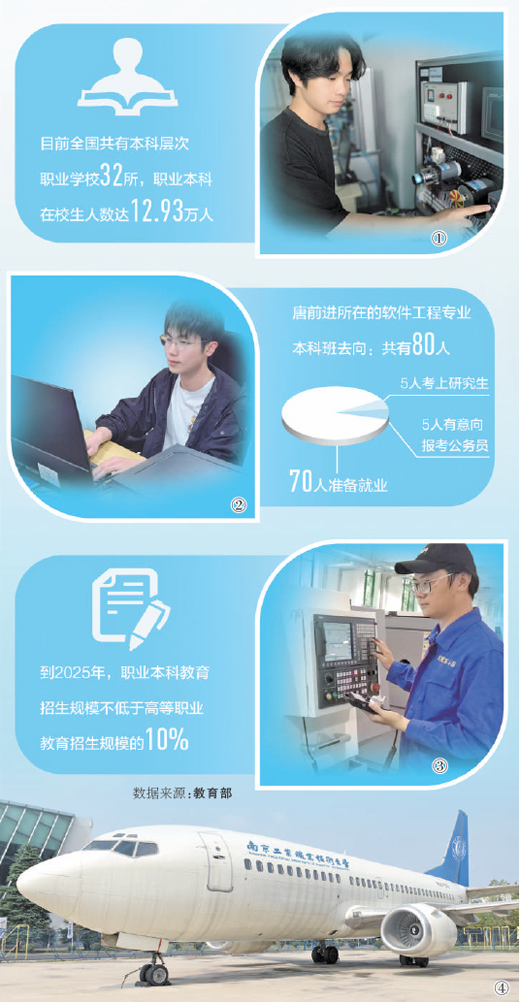
Figure ④: Outdoor aviation training base of School of Aviation Engineering, Nanjing University of Technology. Shen Jianshe Source: Ministry of Education
On May 1st, the newly revised Vocational Education Law came into effect. The Vocational Education Law clearly stipulates that higher vocational school education is implemented by higher vocational schools and ordinary colleges and universities with junior college, undergraduate and above education levels. This means that the "ceiling" of vocational education at the junior college level has been broken, forming a "through train" from secondary vocational schools, junior colleges, undergraduate courses to graduate students. Among them, vocational education at the undergraduate level has attracted much attention. At present, there are 32 vocational schools at the undergraduate level in China, with 129,300 students. The Opinions on Promoting the High-quality Development of Modern Vocational Education clearly states that by 2025, the enrollment scale of vocational undergraduate education will not be less than 10% of that of higher vocational education, and the attraction and training quality of vocational education will be significantly improved.
How do you feel about studying in a vocational college? Recently, the reporter investigated Nanjing University of Technology, and interviewed three undergraduates who entered the college through three ways, namely, individual recruitment, college entrance examination, and general college entrance examination, to explore the growth path of vocational undergraduate education through their entrance choice, study experience and graduation way.
Enter school
Won the second prize of the National Professional Skills Competition, and the secondary vocational students realized their undergraduate dream.
In 2018, the first prize of Yancheng Electromechanical Integration Skills Competition in Jiangsu Province, the first prize of Jiangsu Electromechanical Integration Skills Competition in 2019, and the second prize of National Electromechanical Integration Skills Competition in 2019 & HELIP; … Despite these dazzling honors, going to college was once a distant dream in Wu Yunze’s mind (see Figure 1, photo by Song Haichao).
Born in 2001, Wu Yunze’s hometown is Yancheng, Jiangsu Province. He has been lively and active since childhood, and his hands-on ability is very strong, but his academic performance has not been excellent. After the senior high school entrance examination, Wu Yunze went to a secondary vocational school. Although this choice is more passive than active, what he and his parents didn’t expect was that in the three years of vocational school, his advantage of strong hands-on ability gradually emerged and became a veritable "schoolmaster".
Programming is Wu Yunze’s specialty. Speaking of the experience of participating in the skills competition, Wu Yunze can’t hide his excitement: "The USB flash drive has four parts: the upper shell, the lower shell, the chip and the cover. How to form a complete product? By hand? Wrong. Now it is the era of intelligent manufacturing. In the mechatronics project, players have to send instructions to machines and equipment through programming, and the machines will complete the assembly process. My secret of victory is — — Pay attention to strategy, make overall planning, and do more parallel processing! "
However, before graduating from secondary vocational school, Wu Yunze went to the talent market with a stack of award-winning certificates, but the positions provided by the employer and the wages offered were difficult to satisfy him. What should we do?
The head teacher encouraged him to try the "one-on-one-off" test of the vocational college entrance examination, that is, the separate entrance examination for graduates of secondary vocational schools in ordinary colleges and universities. In the process of preparing for Wu Yunze’s exam, Jiangsu Education Examinations Institute issued a new reward policy for counterpart single strokes in 2020. "Candidates who won the second prize of the National Professional Skills Competition and above or the first prize of the Provincial Professional Skills Competition can be directly admitted to the provincial undergraduate colleges according to their wishes.". This made Wu Yunze overjoyed.
In 2020, Wu Yunze chose Nanjing University of Technology, which had just opened an undergraduate major, and filled in his major in mechanical and electronic engineering, which he was interested in, and was successfully admitted.
In 2019, with the approval of the Ministry of Education, Nanjing Industrial Vocational and Technical College was upgraded to the first public vocational undergraduate school in China, and in 2020 it was renamed Nanjing Industrial Vocational and Technical University. The first batch of 6 undergraduate majors, including mechanical and electronic engineering technology, enrolled 1,936 students, including four-year starting point for secondary vocational schools, two-year starting point for junior colleges and four-year starting point for ordinary high schools. Wu Yunze was lucky to be one of them.
At a welcome activity after entering school, Wu Yunze met Xiao Xinyang, a younger brother of the same major (see Figure ③, photo by Song Haichao). Hearing that Xiao Xinyang graduated from an ordinary high school and passed the college entrance examination, he carefully asked, "Is it a bit of a loss?" "The second line has more than 410 points, and the admission line of our school is 471 points. I got 477 points, which is not a waste." Xiao Xinyang, who is cheerful, said, "There are also voices of opposition and incomprehension when filling in the volunteers. I think so. The vocational undergraduate course is also an undergraduate course, and I can learn one more skill and go one more way."
Xiao Xinyang envies Wu Yunze’s practical experience and has a relatively objective understanding of himself. "My learning ability is OK, but I don’t have practical experience now, and I will have it in the future."
Out of the way
There are 80 students in a class, 5 of whom are admitted to graduate schools, 5 of whom apply for civil servants, and 70 of whom are ready for employment.
Tang Qianjin (see Figure 2, photo by Zhang Zhenfeng), a 2020 software engineering major at Nanjing University of Technology, enrolled in the same year as Wu Yunze, is an undergraduate who entered the school through a junior college.
"My college is in our school. From vocational college to vocational undergraduate, the curriculum and training program of integration of production and education are highly connected, and students are easy to adapt." Tang Qianjin said that in order to enhance the competitiveness of employment, nearly half of the 41 students in the original class had the intention of upgrading to undergraduate courses, and finally they were successfully admitted to more than 10 students, five of whom chose to study in the vocational undergraduate major of our school.
Entering the second semester of grade two, Tang Qianjin started his post practice. According to the relevant regulations and procedures of internship, he chose a smart medical enterprise. "Through the internship, I basically mastered the technical requirements of the post. If I am formally hired after the internship, my monthly salary will reach 13,000 yuan, which is double the income when I applied for a job two years ago, and my position has changed from the previous maintenance position to the development position." Tang Qianjin said.
Tang Qianjin’s project is to match appropriate rehabilitation courses and training programs for patients in cooperative hospitals through artificial intelligence. Shortly after the internship began, Tang Qianjin found that the user interface client had a defect: after the screen of the mobile phone was locked, some data might be lost. Soon, under the guidance of the enterprise tutor, he submitted a solution: serializing the easily lost data and storing it on disk.
This made the team leader look at Tang Qianjin with new eyes: "It’s quick to get started and can solve practical problems!" "I have taken courses related to Android development at school, and page persistence is one of the contents." Tang Qianjin said.
In addition to direct employment, in Nanjing University of Technology, some students choose to continue their studies or take the civil service examination. There are 80 undergraduates majoring in software engineering in which Tang Qianjin works. Five of them have been admitted to graduate schools, five are interested in applying for civil servants and 70 are ready for employment. As of May 26th, more than 82.5% of the students have found employment units.
Xiao Xinyang made up his mind to continue his postgraduate studies since he entered the school. He set the postgraduate entrance examination as a professional master, hoping to become a research and development and management personnel in the manufacturing industry. "The improvement of professional skills in these four years will be my advantage, and studying for a master’s degree can help me go further on this road." Xiao Yuyang said.
Cultivate
We should not only have hands-on ability, but also master the principle behind it.
Wu Yunze, who has entered the second semester of his sophomore year, has a full schedule every day. Going to the library is a habit he developed after he came to college.
"When I was in secondary vocational school, I paid attention to my hands-on ability. I spent a lot of time preparing for the competition and swallowed the principles behind the technology. After arriving at the university, the curriculum requirements are different, and the theory must be learned and understood. It is necessary to read a lot of professional books to expand. " Wu Yunze said. From secondary vocational school to undergraduate course, do you feel hard? Wu Yunze is quite confident: "Facts have proved that secondary vocational students can learn undergraduate courses well as long as they work hard. The teachers are very patient and I have adapted well. "
Song Haichao, deputy director of the Engineering Technology Training Center of Nanjing University of Technology, is responsible for giving the first professional basic course — — Mechanical drawing.
"In the same major, the training direction of undergraduates is the same, and the training idea of integration of production and education is also the same, but the teaching plan and curriculum are different for different students." Song Haichao introduced that Wu Yunze had experience in drawing learning in secondary vocational schools, and he only needed 32 class hours to directly cut into the actual production case projects; Xiao Xinyang has never been exposed to drawing before, so he has to attend 56 class hours, starting with drawing standards and tool steps, and then gradually introducing practical cases.
Song Haichao said that the reason for setting up the teaching plan in this way is that students from ordinary high schools are strong in understanding, and it is more in line with the characteristics of students to start with principles and guide practical exercises. The practical ability of students from secondary vocational schools is an advantage. Starting from solving problems and promoting the understanding of the principles behind them can further improve the technical level.
In the training base of Nanjing University of Technology, the machine tools for processing different parts are lined up, the blackboard and desk are located in the middle of the machine tools, and the classroom is in the production line.
Teacher Zhao Rong, who is in charge of the metalworking training for freshmen, said, "The metalworking training requires that the operations of fitter, lathe worker, milling worker, grinder and other types of work should be carried out within three weeks. Students who come from secondary vocational schools have studied a certain type of work before, and now they should master the whole chain skillfully; Students who come from ordinary high schools should not only have practical ability, but also pay attention to cultivating R&D design and innovation consciousness. "
In order to adapt to the particularity of vocational undergraduate courses, teachers also need to "make up for each other’s shortcomings" in order to achieve the integration of theory and practice and the combination of work and study, and meet the requirements of the construction of "double-qualified" teachers.
After graduation, Dr. Song Haichao went to work in the school. When he first entered the school, he had confidence in theory and had no idea about practical operation. In this regard, the school arranged for him to practice in the enterprise for half a year, develop horizontal topics, accumulate industry experience, obtain skill certificates, and then the old teacher took the lecture to complete the teaching practice for half a year. Zhao was honored to have won the title of national technical expert, and he has rich working experience in enterprises. When he first entered the school, the school arranged senior teachers to pair up with him to improve the teaching level.
Not coming
Deep theoretical foundation, complete knowledge system, compound professional ability and solid accumulation of technical skills.
In less than 10 days, the 2022 college entrance examination will be held soon, and another group of students will face choices when they fill in their volunteers. Can vocational education at the undergraduate level, which has broken the "ceiling" of junior college education, get more recognition? This not only directly affects the choice of candidates and parents, but also affects Wu Yunze’s career development prospects and the composition of future manufacturing practitioners.
Chen Ziji, director of the Department of Vocational Education and Adult Education of the Ministry of Education, responded that after the National Vocational Education Conference in 2021, the "what", "how to do" and "what to do" of vocational undergraduate education became the focus of social attention. "The development of vocational undergraduate education is the inevitable result of the interaction of external needs and internal needs. It not only meets the needs of economic and social development for high-level technical and technical talents, but also responds to the needs of the broad masses of people for high-quality employment and education, and also conforms to the development trend of vocational education and higher education in the world." Chen Ziji said.
As a new thing, it is equally interesting how vocational education at undergraduate level is different from ordinary undergraduate education, while maintaining and giving play to its advantages.
"Vocational undergraduate education, as the undergraduate level of vocational education and the professional type of undergraduate education, is neither a vocational college education ‘ Extended version ’ , nor is it applied undergraduate education ‘ Copy version ’ 。” Wu Xuemin, secretary of the Party Committee of Nanjing University of Technology, understands the characteristics of vocational education undergraduate. "The training of vocational and technical talents with long academic system can enable students to have a deeper theoretical foundation, a more complete knowledge system, a more complex professional ability and a more solid accumulation of technical skills."
Indeed, from the demand side, the future has come. The digital industrialization and industrial digitalization that are taking place in the manufacturing industry have put forward an urgent demand for skilled talents. "5G, industrial Internet and big data have brought about the transformation and upgrading of the manufacturing industry. Simple and repetitive operators have gradually been replaced by artificial intelligence. The scene of a master operating a machine tool until retirement is gradually disappearing. In modern industries and enterprises, front-line positions need high-level compound technical talents who can handle various complex problems on the spot. " Wu Xuemin said.
From junior college to undergraduate course, the improvement of the quality of skilled personnel training is more fundamental than the improvement of academic qualifications.
"Promoting the development of vocational education at the undergraduate level is a key measure to enhance the adaptability of vocational education." Mi Jing, dean of the Vocational Education College of Tianjin Vocational and Technical Normal University, who has been studying vocational education for a long time, is deeply touched. "To build vocational education at undergraduate level with high standards is to aim at the direction of technological change and industrial optimization and upgrading, focus on the high-end level of the technical and technical talent chain, and cultivate high-level labor and entrepreneurs, so as to realize the strategic purpose of vocational education adapting to the requirements of economic development and fully supporting the development of emerging strategic industries and the transformation and upgrading of the real economy."
At present, Wu Yunze is about to usher in the exam week, and spends every day studying in the studio or library until 10 pm. When switching freely between the bookshelf in the library and the lathe in the studio, he often thinks of the choice he made two years ago and feels that the road is "right". The young man has his own expectations for the future: "hone professional theory and technology, and his career ideal is to work in a large manufacturing enterprise, starting with a technical post, then going to a research and development post, and finally winning a management post!"